Four specifications determine whether an industrial paper shredder will work in your operation: rated throughput, rotor configuration, output particle size, and dust control. Get the throughput sizing wrong and the machine becomes the bottleneck in your line within a year. The rest of this article covers what each spec means in practice and how to size it against your actual material.
An industrial paper shredder is a heavy-duty machine built for continuous operation, processing tonnes of paper-based material per hour. Office shredders are built for intermittent, light-duty use and rate their capacity in sheets. Industrial machines rate theirs in kg/hr — a difference of roughly three orders of magnitude. They handle confidential document destruction, but the larger application is recycling: corrugated cardboard, bales, production waste, paper cores, and mixed media including CDs, hard drives, and credit cards. Genox builds six machine series across the industrial paper shredder range, from 18.5 kW document destruction units to 320 kW mill waste processors.
Three application environments account for most industrial paper shredder installations, and each puts a different constraint on the machine.
Corrugated cartons, void fill, and damaged packaging arrive in high volume but low bulk density. The constraint here is volume throughput, not torque — a distribution center shredding 2 tonnes of cardboard per shift needs feed-chamber capacity more than cutting force.
Bound files, ledger books, and boxed archives come with binders, staples, and occasional hard drives mixed in. The constraint is contamination tolerance and output uniformity — output particle size has to meet the destruction standard being certified against, and the rotor has to survive metal fixings.
Rolls, cores, and trimmings are the opposite problem: low volume, high density. A wound paper core concentrates the entire cutting load on a small contact area. The constraint is torque and rotor robustness.
Every industrial paper shredder purchase comes down to four numbers, and throughput is the one most often sized incorrectly.
Match the machine's kg/hr rating to your average daily volume, then size up. Select a model whose rated throughput is 1.5 to 2 times your expected peak hourly volume. That headroom covers bale density variation — the same nominal tonne of baled cardboard can vary widely in how fast it feeds — and leaves room for volume growth without a second capital purchase.
Machines rated at exactly your peak volume run at 100% load during peaks, which accelerates wear on knives, bearings, and the drivetrain.
Single-shaft shredders use a rotor carrying cutting knives that shear against fixed counter-knives, with a screen beneath the rotor controlling output size. They produce uniform particle sizes, which makes them the standard choice for recycling operations and for document destruction where output has to meet a specification.
Counter-knife adjustability matters more than most buyers check. Cutter clearance widens as knives wear; if the counter-knives cannot be adjusted to compensate, cutting quality degrades before the knives themselves need replacing.
Output size is set by the screen aperture, and different applications need different sizes — a baler feed and a certified destruction output are not the same specification. Specify machines with quick-change screens so particle size can be adjusted without a scheduled teardown.
Paper dust is combustible. Specify sealed cutting chambers and dust extraction ports as standard, and evaluate spark detection where the material stream includes anything that could produce ignition.
On the automation side, variable-frequency drive, auto-reverse on overload, and PLC integration with upstream conveyors and downstream balers reduce operator hours per tonne processed.
For total cost of ownership, three line items dominate over a machine's life: blade material, whether blades can be resharpened and reused, and screen replacement cost. Purchase price is usually the smaller number over a 10-year horizon.
GENOX builds its paper shredder range around low-to-medium-speed, high-torque cutting. Lower rotor speed reduces the energy with which cut particles are released, which limits airborne dust at source rather than extracting it afterward — the reason the same technology handles newspaper, magazines, confidential documents, paperboard, and corrugated cartons on one line without secondary contamination.
| Series | Power | Throughput | Best fit |
|
V Series Single shaft |
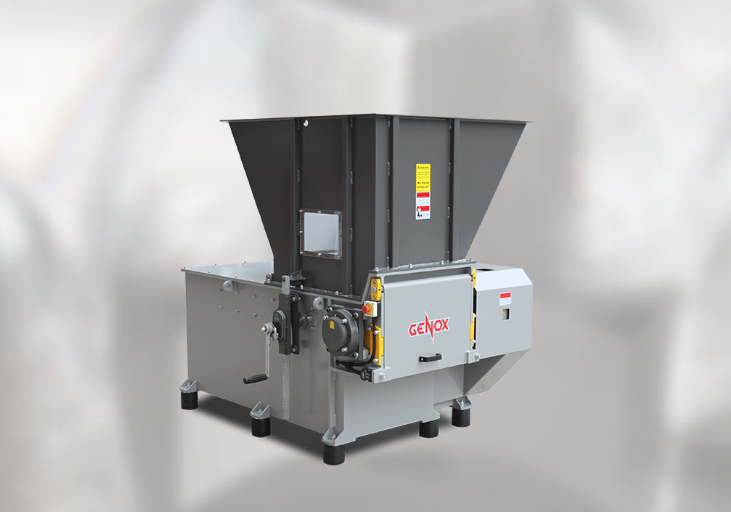
18.5–75 kW | 300–5,000 kg/hr | Mid-volume archive destruction, packaging waste, warehouse carton volume reduction. Long-life counter-knives are adjustable to maintain cutter clearance. |
|
BH Series Single shaft |
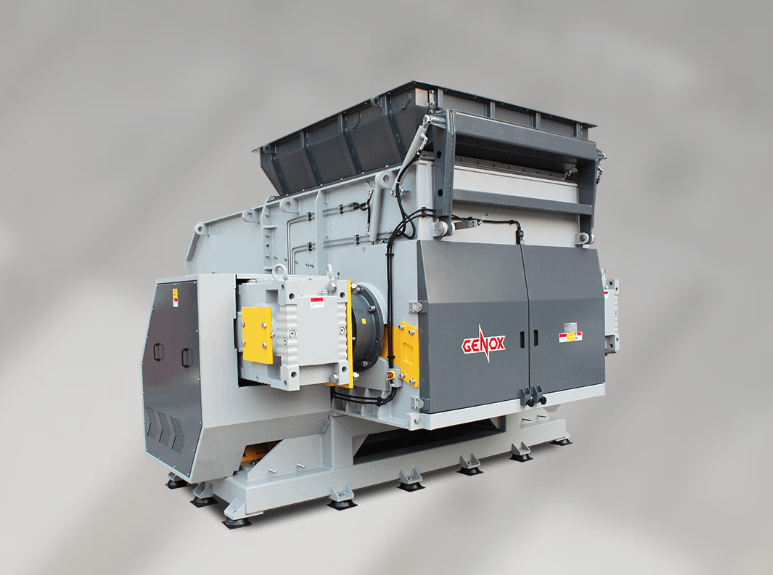
90–320 kW | 1,500–12,000 kg/hr | High-hardness, dense-load material including laminated board and paper cores. Reinforced rotor and wear-resistant structure for continuous heavy-duty cycles. |
|
|
| V Series — 18.5–75 kW, 300–5,000 kg/hr | BH Series — 90–320 kW, 1,500–12,000 kg/hr |
Applying the 1.5–2× rule to this range: an operation with a peak hourly volume of 2,000 kg should be looking at the upper end of the V Series or the entry point of the BH Series, not a machine rated at exactly 2,000 kg/hr.
The four specs are not equally weighted. Rotor configuration, particle size, and dust control can be specified after a supplier conversation — throughput cannot, because it determines which machines are even in the conversation. Calculate your peak hourly volume first, multiply by 1.5 to 2, and use that number as the floor for every quote you request.
Explore the full industrial paper shredder range, or send us your material and volume for a sizing assessment.
An industrial paper shredder is a production-grade machine that processes paper, cardboard, and paper-based waste at rates measured in kg/hr rather than sheets. It runs continuously rather than intermittently, and handles material an office shredder cannot: baled cardboard, wound paper cores, bound archives, and mixed media.
Calculate your peak hourly volume in kg, then select a machine rated at 1.5 to 2 times that figure. The headroom absorbs bale density variation and volume growth. Sizing a machine to exactly your peak volume means running at full load during every peak, which shortens knife and bearing life.
In industrial recycling the terms overlap — most industrial paper shredders process corrugated cardboard as standard. The practical difference is configuration: cardboard-focused setups prioritize volume throughput and feed-chamber size, while document-focused setups prioritize output uniformity and a finer screen aperture. Both configurations are available across the Genox paper shredder series.
Yes. Paper dust is combustible, which is why sealed cutting chambers and dust extraction ports are standard specifications rather than options. Low-to-medium-speed rotor designs reduce dust generation at source, and spark detection can be added where the material stream carries ignition risk.
Wear parts, not purchase price. Blade material and whether blades can be resharpened, plus screen replacement cost, are the recurring line items across a machine's service life. Ask any supplier for the cost of a full knife set and a replacement screen before comparing quotes.
 EN
EN CN
CN ES
ES AR
AR RU
RU FR
FR DE
DE FA
FA NL
NL