Choose plastic recycling equipment based on feedstock form first, target output quality second, and throughput capacity third. Buyers who reverse that order — selecting machines by price or nameplate capacity before confirming material compatibility — typically face a retrofit within 18 months or a contamination rejection from their first pellet customer. This guide covers each process stage, the equipment decision at each stage, and the selection criteria that determine whether a line runs profitably.
Every mechanical plastic recycling line — regardless of resin type or application — moves material through four sequential stages: size reduction → washing → dewatering → pelletizing. Skipping or underspecifying any stage creates bottlenecks that constrain the entire line's output quality and throughput.
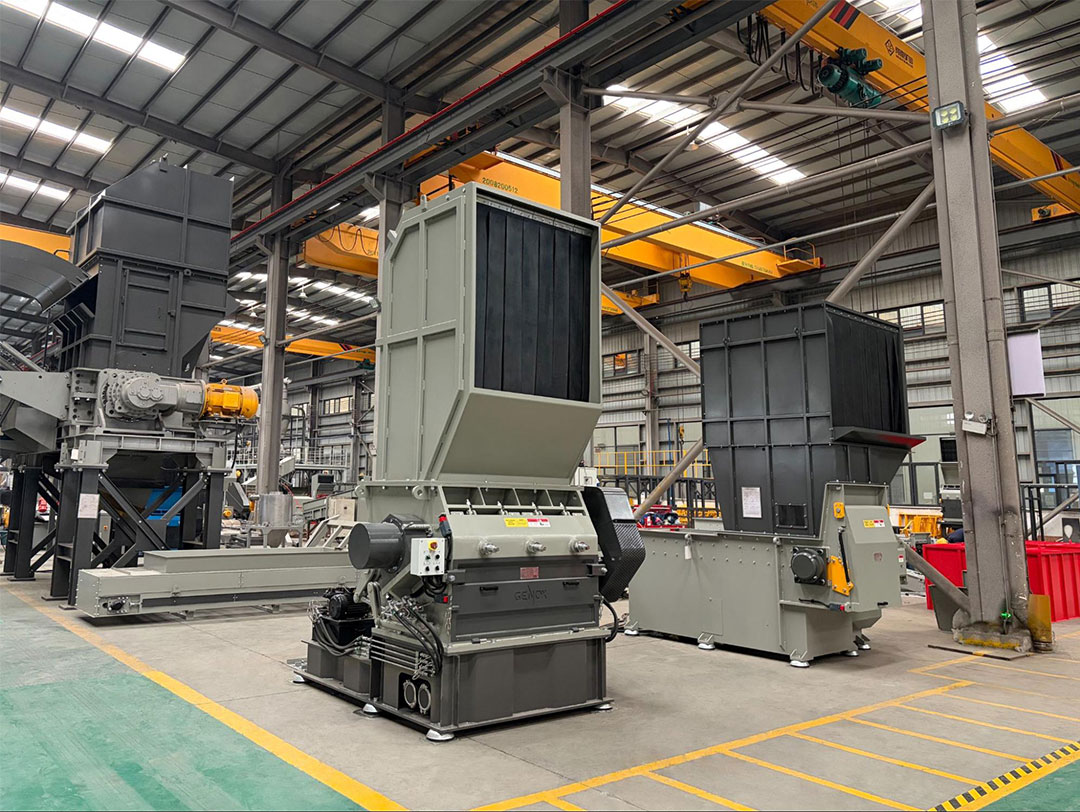
Size reduction produces consistently sized flake that downstream washing and pelletizing equipment can process reliably. Two machines handle this stage in sequence: a shredder for primary volume reduction and a granulator for uniform particle sizing.
Plastic shredders cut material to 20–80 mm fragments using a tearing or shearing action. They handle rigid forms (pipes, drums, crates, bottles) and flexible forms (films, woven bags) with different blade geometries — confirm blade configuration matches your dominant feedstock before specifying.
Plastic granulators (also called crushers) then refine shredded fragments to uniform 8–12 mm flakes. Consistent particle size at this stage directly determines feed stability into washing tanks and extruder hoppers downstream.
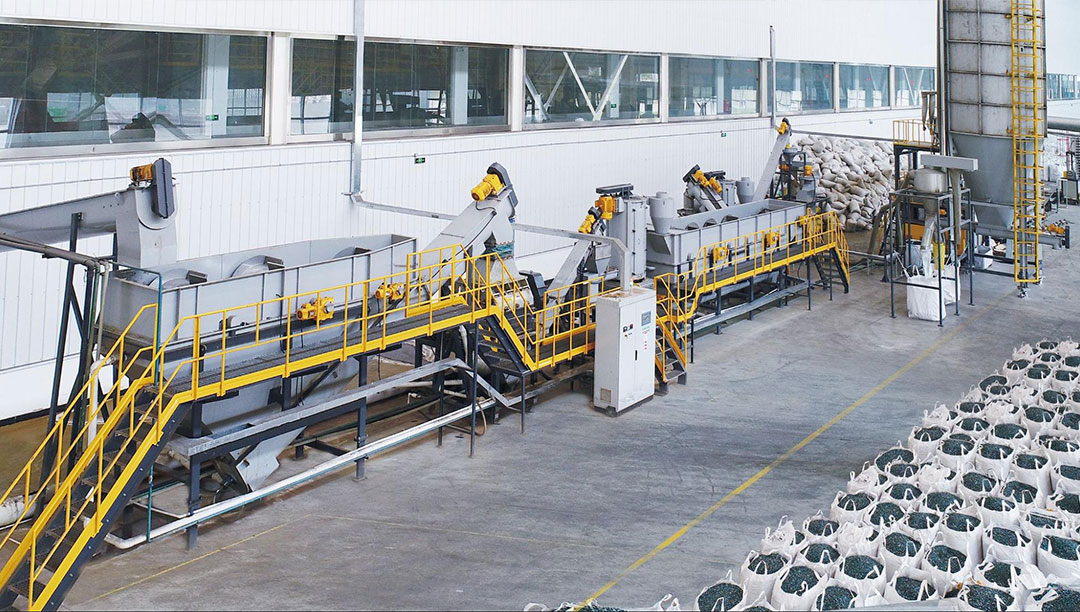
Washing equipment selection depends on contamination type and the purity level your end market requires. Post-consumer plastic carries labels, adhesives, food residue, soil, and mixed polymer contamination — a single-stage wash is insufficient for most commercial applications.
A standard multi-stage washing line runs in this sequence:
Before outlining each stage, note that the configuration below applies to post-consumer rigid plastic. Film and flexible packaging lines use a modified sequence — see Section 4 for dewatering differences that also affect wash line design.
GENOX's 3T/h food-grade HDPE washing line has received an FDA No Objection Letter, confirming it meets the purity specifications required for food contact material applications.
View the HDPE washing line →
Moisture remaining in washed flake converts to steam inside the extruder barrel, producing bubbles, voids, and pellet degradation. Two equipment types handle dewatering, and the choice is determined by material form — not personal preference.
Centrifugal dryers spin material inside a perforated screen drum, flinging bulk water out by centrifugal force. They are effective for rigid plastics — bottles, pipes, crates — where water sits on the surface rather than trapped in the material structure.
Squeeze dryers apply mechanical pressure to force water out of low-density films and woven bags. These materials trap water in their structure in a way that centrifugal force cannot reach. If your feedstock is predominantly film or flexible packaging, a squeeze dryer is not optional — it is the determining factor in pellet quality.
Pelletizing melts, filters, and forms dried flake into uniform pellets — the output format accepted by injection molding, blow molding, and film extrusion equipment. Three pelletizing technologies are in commercial use, each suited to a different material profile:
Strand pelletizing is the most widely deployed method. The extruder pushes molten plastic through a die into strands, which cool in a water bath before a rotary cutter sizes them into pellets. It handles most rigid resin types reliably and at lower capital cost than alternatives.
Underwater pelletizing (UWP) cuts strands immediately after the die face, inside a water-filled cutting chamber. This produces spherical pellets with tighter dimensional consistency and better bulk flow characteristics — preferred for compounding applications and high-value resin grades.
Cutter compactor pelletizing is designed for low-density materials: films, bags, and fiber. A cutter compactor densifies the material first — addressing the bridging and air-pocket problem that prevents loose film from feeding consistently into a standard extruder hopper — before routing it into the extrusion stage.
Equipment selection follows a consistent sequence regardless of operation size. Work through these five criteria before issuing any request for quotation.
The physical form and contamination profile of your feedstock determines every downstream equipment decision. Rigid plastics, flexible films, woven bags, and mixed post-consumer waste each require different shredder geometries, washing configurations, and pelletizing approaches. Confirm resin type compatibility — PET, HDPE, Low-Density Polyethylene (LDPE), PP, Polystyrene (PS) — with the equipment supplier before proceeding.
Equipment capacity is rated in kilograms per hour (kg/h). Size for current peak volume plus a 20–30% margin to avoid a capacity-limited retrofit during your first expansion cycle.
Food-contact applications require multi-stage washing with hot-wash capability and documented purity certification — a cold-wash line will not meet the specification regardless of how many stages it includes.
A recycling line runs profitably only when it runs continuously. Before committing to a supplier, confirm:
Account for energy consumption in your operating cost model. Power is a major recurring cost in any recycling facility.
The four stages covered here — size reduction, washing, dewatering, and pelletizing — are interdependent. Underspecifying one stage limits what every stage after it can achieve. A granulator producing inconsistent flake sizes, for example, will cause feed instability in both the washing tanks and the extruder, regardless of how well those downstream machines are sized.
The right sequence for any equipment decision is: feedstock profile → output quality target → throughput requirement → supplier verification. GENOX engineers can run your specific material on test equipment before you commit to a line configuration. Contact us →
A shredder performs primary size reduction, cutting bulk plastic to 20–80 mm fragments. A granulator refines those fragments to a uniform 8–12 mm flake size suitable for washing and pelletizing. Most recycling lines use both in sequence: shredder first, granulator second.
Hot-wash capability — typically 80–95°C with a NaOH solution — is required when processing material destined for food-contact applications, or when adhesive contamination from labels cannot be removed by friction washing alone. Cold-wash lines are sufficient for non-food-grade industrial applications.
Strand pelletizing cools extruded strands in a water bath before cutting — lower capital cost, suitable for most rigid resin types. Underwater pelletizing (UWP) cuts at the die face inside a water chamber, producing more spherical pellets with tighter dimensional consistency. UWP is preferred for compounding applications and high-fluidity resin grades.
Not on a single line configuration without modification. Rigid plastic and flexible film have different size reduction requirements (blade geometry), dewatering requirements (centrifugal vs. squeeze), and pelletizing requirements (standard extruder vs. cutter compactor). Facilities processing both material types typically run separate lines or invest in convertible equipment with significant changeover time.
| Stage | Primary equipment | Secondary equipment | GENOX product line |
| Size reduction | Pre-shredder | Granulator | YS Series Pre-Shredder, V Series Shredder, GC Series Granulator |
| Washing | Float/sink tanks, friction washer | Hot washer (food-grade) | HDPE Washing Line (FDA No Objection Letter), PE Film Washing Line |
| Dewatering | Centrifugal dryer (rigid) | Squeeze dryer (film/flexible) | Integrated Drying System |
| Pelletizing | Strand pelletizer | UWP, Cutter Compactor | GENOX Pelletizing System |
 EN
EN CN
CN ES
ES AR
AR RU
RU FR
FR DE
DE FA
FA NL
NL