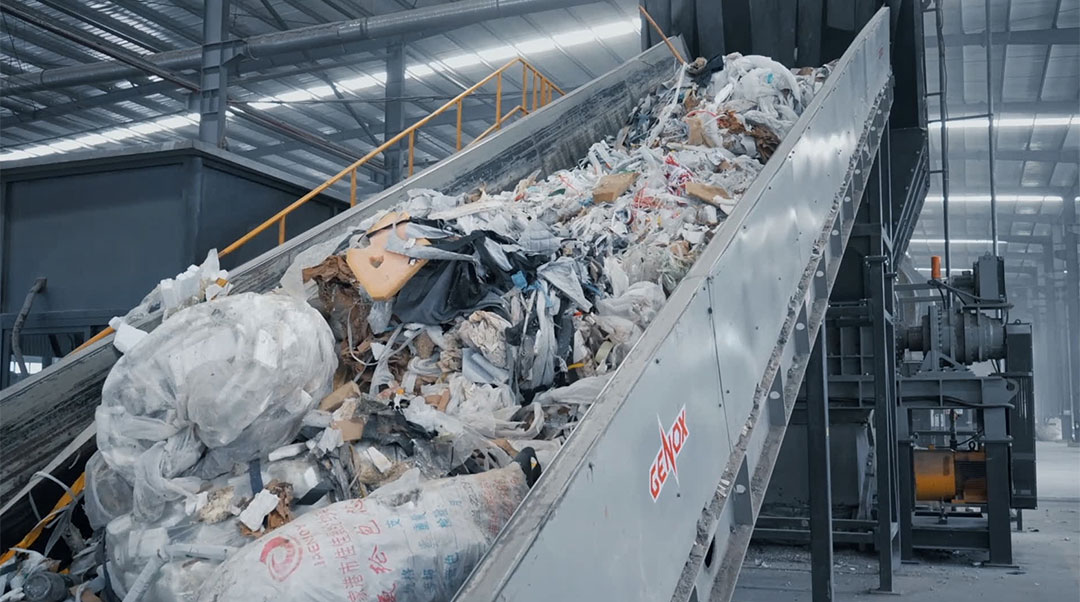
Refuse-Derived Fuel (RDF) is manufactured from the combustible fractions of municipal solid waste (MSW) — plastics, paper, wood, and organic residues — through drying, shredding, and compaction. The resulting fuel substitutes directly for coal and natural gas in cement kilns, industrial boilers, and waste-to-energy (WtE) power plants, diverting waste from landfill while generating measurable calorific output. The economics of large-scale RDF production depend almost entirely on shredder performance: a line that stalls on contaminants or produces inconsistent particle sizes fails at both ends — fuel quality and throughput.
Solid-Recovered Fuel (SRF) occupies a different market position from RDF. SRF is manufactured from pre-sorted industrial waste streams under EN 15359 classification standards, with controlled moisture content (typically below 15%) and a documented net calorific value. RDF is produced from broader, less sorted MSW inputs and carries more variable quality — but it enters a larger market and is forecast to grow steadily as industries shift toward lower-cost combustion fuels.
RDF shredders handle heterogeneous MSW through three core design features: high-torque, low-speed drive systems, advanced feeding mechanisms, and multi-row staggered cutting geometry. Each addresses a specific failure mode that generic industrial shredders cannot manage reliably on mixed waste.
MSW arrives as a chaotic mixture of plastics, textiles, paper, wood, metals, glass, organic matter, and inert material. Calorific value fluctuates across input batches. Unprocessed waste commonly exceeds 30% moisture content. Metallic and glass contaminants damage cutting components and degrade combustion quality in downstream equipment. The three design features above address each of these issues directly:
High-torque, low-speed operation allows the shredder to grip and tear dense or bulky material — timber beams, mattresses, bundled textiles — without stalling. Drive torque is prioritized over rotational speed, which is the opposite of granulator design logic.
Advanced feeding mechanisms maintain consistent rotor loading even when input geometry is irregular or voluminous. Inconsistent feeding is the primary cause of throughput variation in MSW processing lines.
Robust cutting systems with staggered knife rows and multiple cutter passes ensure uniform size reduction across mixed material. GENOX shredder cutting components use.
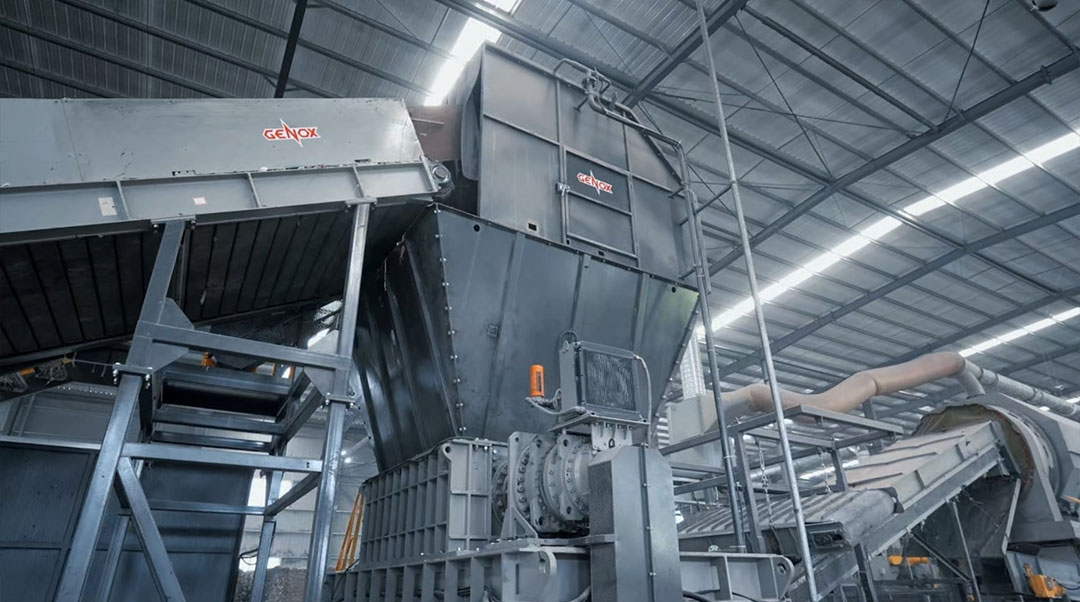
RDF production moves raw mixed waste through four sequential stages. Each stage integrates separation technology alongside size reduction to maximize both fuel quality and recoverable material yield.
Raw MSW enters a primary shredder via an infeed conveyor or wheel loader. The pre-shredder reduces bulk volume and opens sealed containers — bags, crates, bales — that would otherwise pass intact through downstream screening. GENOX pre-shredders use large-diameter splined shafts, high-strength shredding discs, and oversized gearboxes sized for continuous-duty operation on unclassified waste.
Before fine shredding, three separation technologies remove contaminants that would otherwise reduce fuel quality or damage downstream cutting components:
Light-fraction material from air classification feeds into one or more secondary shredders, sized by line throughput capacity. GENOX fine shredders use a stepped shear-cutting geometry with high-alloy steel blades to achieve consistent output particle size.
The target particle size for RDF is 50–80 mm. Material within this range burns completely in cement kiln flames and WtE boiler fireboxes without unburnt carbon carryover. Output at this stage qualifies as commercial-grade RDF or, if input sorting meets EN 15359 thresholds, as SRF for higher-value combustion markets.
Shredded RDF feeds into a briquetting press or baler that compresses the material to increase bulk density and reduce transport volume. Higher bulk density cuts freight cost per GJ of fuel value and simplifies storage in covered facilities. The pressing step also produces more consistent feed geometry for end-user combustion equipment, improving burnout uniformity in cement kiln precalciners and WtE grate systems.
An integrated control system links all process units — conveyors, shredders, screens, separators, and presses — so that each machine's operating state is visible and adjustable from a single supervisory interface. When a downstream unit signals high load or a fault condition, upstream feed rates reduce automatically to prevent material buildup. Contaminant detection triggers diverter gates without manual intervention.
GENOX integrates automation across the full RDF line, from infeed to packing. View the RDF line →
Most RDF line underperformance traces back to three specification decisions made before equipment is ordered.
Input characterization. The variability of your MSW input — moisture range, bulk density, maximum dimension of bulky items, metal content — determines rotor diameter, drive power, and required blade change intervals. A shredder specified on average input properties will underperform on peak-variability days, which in MSW processing are frequent.
Throughput margin. RDF lines are typically sized to nameplate capacity with no buffer. MSW sorting facilities, permit conditions, and fuel offtake contracts all vary seasonally. Size the shredder at 120–130% of current peak volume, not average volume, to avoid capacity-limited bottlenecks during high-input periods.
Particle size target vs. market. The 50–80 mm standard suits cement kilns and moving-grate WtE boilers. Stoker-fired boilers and some industrial co-firing applications accept up to 100 mm. Confirm your offtake buyer's specification before setting screen aperture — oversized output loses fuel contracts; undersized output increases energy consumption per tonne without proportional fuel-value benefit.
GENOX engineers run customer-supplied material samples on test equipment before line specification is finalized. Contact the GENOX technical team to arrange a material trial: https://www.genoxtech.com/en/contact.html
Refuse-Derived Fuel (RDF) is produced from the combustible fractions of municipal solid waste — primarily plastics, paper, wood, and organic residues — through a four-stage process: pre-shredding, screening and separation, fine shredding, and compaction. The output is a fuel pellet or bale with a standardized particle size of 50–80 mm, used as a coal substitute in cement kilns, industrial boilers, and waste-to-energy power plants.
SRF (Solid-Recovered Fuel) is manufactured from pre-sorted industrial waste streams under EN 15359 classification, with controlled moisture content and documented net calorific value. RDF is produced from broader, less sorted municipal solid waste inputs. SRF commands a premium in energy markets; RDF serves a larger, more accessible market. Both require the same basic shredding process — the difference is input sorting quality and output specification stringency.
The target particle size for RDF is 50–80 mm. Material within this range achieves complete combustion in cement kiln flames and waste-to-energy boiler fireboxes. Larger particles risk unburnt carbon carryover; smaller particles increase fine shredder energy consumption without proportional fuel quality benefit.
A primary RDF shredder operates at low rotational speed with high drive torque to tear and shear bulky, heterogeneous waste — including metals, textiles, and contaminated organics — without stalling. A granulator operates at higher speed for uniform size reduction of pre-classified, cleaner material. RDF lines require the primary shredder's torque capacity; a granulator cannot handle unclassified MSW reliably.
Not at production scale. Pre-shredding and fine shredding impose different mechanical demands: the primary shredder needs maximum torque to handle bulk volume and hard contaminants; the secondary shredder needs precise particle size control to hit the 50–80 mm target. Running a single machine in both roles forces compromises on both blade geometry and operating speed that reduce throughput and output consistency.
 EN
EN CN
CN ES
ES AR
AR RU
RU FR
FR DE
DE FA
FA NL
NL